Litchi Cultivation in India: How to Grow & Top Litchi-Producing States


Litchi cultivation in India is gaining importance due to its high demand and potential to earn higher profits. Its cultivation is a long process and requires utmost care as litchi plants are sensitive to climate, temperature, and location. In this blog, we have discussed all aspects of litchi cultivation in detail, starting from agro-climatic conditions and site selection, to harvesting.
Table of Contents
- Litchi Cultivation in India
- Nutritional Profile of the Litchi Fruit
- What are the Different Varieties of Litchi Grown in India?
- Which are the Top States in Litchi Production in India?
- What are the Climate and Soil Requirements for Litchi Cultivation?
- Different Vegetative Methods of Propagating Litchi
- What are the Steps involved in Establishing Litchi Orchards?
- Site Selection for Litchi Orchard
- Land Preparation for Planting Litchi
- Pit Preparation for Planting Litchis
- Planting of Litchis
- Training & Pruning of Litchi
- Nutrient Management of Litchi
- Irrigation Requirements in Litchi Cultivation
- Intercultural Operations in Litchi Orchard
- Mulching of Litchi Orchard
- Inter-cropping in Litchi
- Pest and Disease Management
- Harvesting and Yield of Litchi
- What is the Economics of Establishing a Litchi Orchard in India?
Litchi Cultivation in India
Litchi (Litchi chinensis Sonn) is a delicious and juicy fruit introduced in India in the 18th century in Tripura. It is a native subtropical fruit of Southern China and Northern Vietnam. Today, litchi cultivation is done on an area of more than 1 lakh hectares spread across 19 states of India. Litchi is an important commercial crop with huge demand and export potential. India grows nearly 33 cultivars of litchi and is the second largest producer after China in the world. The litchi planting in India begins in August-September, with flowering happening in February-March and harvesting taking place in May-June.
Nutritional Profile of the Litchi Fruit
Litchi contains 60% juice, 19% seed, 13% skin and 8% rag. The content composition may vary and depends on the variety and climate. It is largely preferred as a table fruit in India. Below is the nutritional value of litchi per 100 g:
|
Component |
Fresh aril (per 100 g) |
|
Moisture |
81-85 % |
|
Potassium |
170 mg |
|
Protein |
0.68-1 g |
|
Sodium |
3 mg |
|
Calcium |
8-10 mg |
|
Carbohydrate |
13.31-16.40 g |
|
Fibre |
0.23-0.40 g |
|
Fat |
0.30-0.58 g |
|
Iron |
0.40 mg |
|
Ascorbic acid |
24-60 mg |
What are the Different Varieties of Litchi Grown in India?
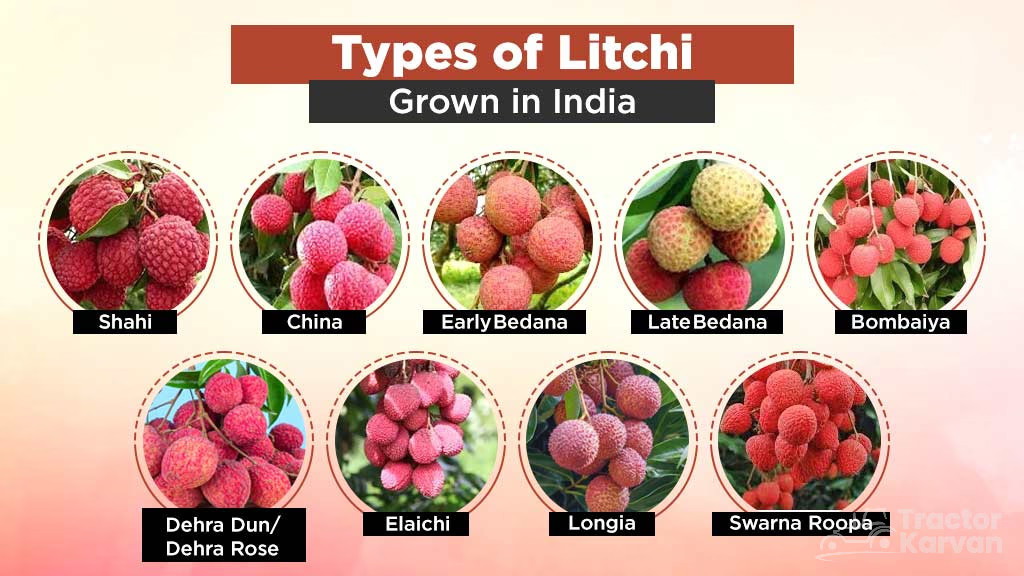
Shahi litchi is the most popular litchi variety in India, known for its distinct rose aroma and is hence called Rose Scented. It is largely cultivated in Muzaffarpur of Bihar, Uttaranchal and Uttar Pradesh. Some of the other popular types of litchi are those given in the table are Ajhauli, Gulabi, Kasba and Kaselia.
|
Variety |
States |
|
Shahi |
North Bihar, Jharkhand, Uttarakhand, Uttar Pradesh |
|
China |
West Bengal, Jharkhand, North Bihar, Uttar Pradesh |
|
Early Bedana |
Punjab and Uttar Pradesh |
|
Late Bedana |
Uttarakhand, Jharkhand, North Bihar |
|
Bombaiya |
West Bengal |
|
Dehra Dun/ Dehra Rose |
Uttar Pradesh and Punjab |
|
Elaichi |
West Bengal |
|
Longia |
North Bihar |
|
Swarna Roopa |
Jharkhand |
Which are the Top States in Litchi Production in India?
Litchi in India is mainly grown in Bihar, Jharkhand, Uttarakhand and West Bengal. With 32,000 hectares of area under litchi cultivation, Bihar is the largest producer of litchi in India. It contributes nearly 40% of the total production.
|
State |
Production in FY2024-2025 (‘000 tonnes) |
Share (%) |
|
Bihar |
136.32 |
23.18 |
|
Punjab |
74.97 |
12.75 |
|
West Bengal |
71.72 |
12.19 |
|
Jharkhand |
63.12 |
10.73 |
|
Assam |
62.75 |
10.67 |
|
Chhattisgarh |
61.76 |
10.50 |
|
Uttar Pradesh |
46.77 |
7.95 |
|
Odisha |
27.27 |
4.64 |
|
Uttarakhand |
19.47 |
3.31 |
|
Himachal Pradesh |
7.64 |
1.30 |
What are the Climate and Soil Requirements for Litchi Cultivation?
Litchi farming in India requires extreme care as it is a very sensitive fruit as far as rainfall, temperature and humidity are concerned. Moreover, it needs a suitable soil to grow. Variations in climatic conditions result in litchi fruits developing cracks and becoming smaller in size. Further, they become less sweet and juicy.
Climate
Growing litchi requires a moist subtropical climate with the absence of winter frost and dry heat in summer. It can grow up to an altitude above 800 m, but it grows best at lower elevations.
- General Temperature: 10˚C (December-February) and 38˚C (April-June)
- Optimum Temperature: Should be up to 32˚C.
- Temperature during Flowering & Fruiting: 21˚C-37.8˚C
Further, a dry climate without rain for nearly 2 months before flowering results in proper flower bud differentiation, blossom and high litchi production.
Soil
In India, litchi is cultivated successfully on a wide range of soil types, but it is best cultivated in alluvial sandy loam soils with access to the water table and good drainage. Litchi grown in sandy soils has a root system network. The pH of soil for growing litchi varies from 7.5-8 in North Bihar to 6-6.5 in Jharkhand. It also grows well in calcareous soil with 30% free lime content.
Different Vegetative Methods of Growing Litchi
Different vegetative methods are adopted for the successful propagation of litchi in India. Besides, sexual and vegetative propagation, the other commonly used methods are:
- Anti-layering
- Pot layering
- Stooling
Anti-layering is the most common vegetative method adopted for Litchi cultivation in India.
What are the Steps involved in Establishing Litchi Orchards?
Litchi plant starts bearing fruits after 5-6 years and attains commercial production stage after 10-12 years. The successful cultivation of litchi involves certain steps, which are mentioned below:
Site Selection for Litchi Orchard
Site selection for growing litchi is very critical as it requires a specific climate at each stage of growth. For instance;
- Prior to flowering during autumn-winter: Dry period
- Flowering, Fruit Setting & Maturity phase: moderate temperature and humidity
- Fruit Development & Maturity: Absence of high-speed wind
- The soil of the selected site must have deep, mild, calcerous, well-drained soils with high organic matter.
Land Preparation for Planting Litchi
Before planting litchi, the field needs to be cleared of weedy vegetation and bushes. Then, deeply plough and level the land with a mild slope in the direction opposite to the water source. Litchis are susceptible to hot and dry winds; thus, breaks need to be planted at the orchard boundary. Add organic matter to improve the soil fertility.
Pit Preparation for Planting Litchis
Before planting litchis, a pit measuring 90 X 90 X 90 cm should be dug in the month of April – May, and the soil should be spread on the ground. Further, the dug pit should be filled with topsoil mixed with 40 kg compost, 2 kg neem cake, 1 kg single super phosphate, 200-300 gm muriate of potash and 20 gm carbofuron.
Planting of Litchis
Planting of litchi should be done in the August-September period, and in case irrigation is available, then it can be done in spring and early summer.
Litchi is an evergreen and spreading plant that can attain a height of 10-12 meters when fully grown. For proper growth of litchi plants, light penetration through the canopy is critical. Thus, a square system of planting with 9 – 12-meter distance between two rows is recommended.
Training & Pruning of Litchi
- At the time of planting: Pruning is necessary to give adequate shape to the litchi plant.
- At the time of harvesting: Removal of shoots bearing the fruit to promote new growth.
- Heavy pruning is required when the litchi trees grow old and produce small-size fruits.
Nutrient Management of Litchi
Balanced nutrition is recommended for both mature litchi trees and young litchi plants. Hence, the application of manure and fertiliser in recommended doses is critical to sustain the regular growth of plants. Further, the nutritional requirement in litchi plants also depends on the soil fertility condition.
Irrigation Requirements in Litchi Cultivation
Irrigation requirements for litchi cultivation are as follows:
- Winter months: Two irrigations at a gap of 45 – 60 days are required for fruit-bearing litchi trees
- Summer months: Irrigation required at an interval of two weeks once fruit sets in March, and to be continued till June
- Irrigation method: Ring/ basin/ drip irrigation method
Intercultural Operations in Litchi Orchard
During the initial years of growth, ensure that litchi orchards are free of unwanted weeds. For this, a reversible MB plough can be used to turn the soil in a litchi orchard. Further, harrowing is necessary, and it can be done twice: once in October after the rainy season and again in June or July at the time of harvesting litchi fruits.
Mulching of Litchi Orchard
Mulching of soil is necessary for the effective growth of litchi plants. The farmyard manure (FYM), straw or compost can be used for mulching. While using straw as a mulch, it can be topped up with an additional dose of 25 – 30 kg Calcium Ammonium Nitrate (CAN) per ton to quicken the decomposition. Another method of mulching is cutting down tall-growing weeds in the orchard and spreading them over the soil.
Inter-cropping in Litchi
Litchi takes about 5-6 years to reach the fruiting stage as it is a long-gestation crop. Thus, inter-cropping is feasible in the first three or four years. Inter-cropping protects the young litchi plant, improves the soil’s physical condition, enriches the soil, and checks the weed growth. Besides, it provides additional income during non-bearing periods.
Pest and Disease Management
Litchi plants are susceptible to mites and the shoot borer. The chances of infestations are higher in the September – October flush and in Tikola and Shahi varieties of litchis. To effectively control it, Cypermethrin (0.01%) can be sprayed twice at a 7-day interval during flushing.
Further, fungicides can be sprayed to effectively control fungal disease Helmenthosporium hawaiense and Aspergillus sp. in fruits. Remember not to apply fungicides on the fruits or trees at least 20 days before harvesting.
Harvesting and Yield of Litchi
Fruiting and ripening of litchi: The litchi plant attains the fruiting stage in 5 – 6 years if the propagation of the plant is done through the air-layering method. Most of the commercial varieties of litchi in India start ripening after 70-100 days of flowering. In India, Litchi starts ripening from 15th April in Tripura.
Yield: Depending on the variety, season, locality, age and nutrition, the litchi tree, on average, yields 40 – 100 kg of fruit per year.
Harvesting: Litchi fruits are usually harvested in May – June when the tubercles of litchi become flat, the epicarp becomes smooth, and the fruit changes colour from green to pink. The litchi fruits are harvested in bunches along with a few leaves and a portion of the branch.
What is the Economics of Establishing a Litchi Orchard in India?
Litchi cultivation is a highly profitable agri-business in India. If litchi is grown in an acre of land, then the total cost would come to ₹1,50,000. Considering the yield would go up from an estimated 2 tonnes in year 5 to 6 tonnes in year 9, the orchard has the potential to give a return of ₹15,000 per tonne. And the gross profit from litchi cultivation from the 5th year is estimated to be ₹1,78,000. Besides, one can also earn from practising inter-cropping in initial 5 years.
Frequently Asked Questions On Litchi Cultivation in India
1. When is the litchi season in India?
May-June is the litchi season in India.
2. Which is the largest litchi-producing state in India?
Bihar is the largest litchi-producing state in India.
3. What are the key varieties of litchi found in India?
The main varieties of litchi in India are Bombai, Bedana, Rose Scented and Shahi.
4. What is the rank of India in litchi production?
India is the second-largest litchi producer in the world.






Related Blogs