Ploughing in Agriculture: Meaning, Types & Tips


Ploughing is an agricultural process of turning over and breaking up the soil using a plough or other farm implements to prepare it for planting. It helps prepare a proper seedbed, boosting the germination rate. Ploughing optimizes soil structure, improves nutrient circulation, and helps manage weeds.
In this blog, we will discuss the different types of ploughs, how they work, popular implements, and provide tips for choosing the right plough.
Table of Contents
- What is Ploughing?
- What is the Importance of Ploughing in Agriculture?
- What are the Advantages of Ploughing?
- What are the Types of Ploughs Available in India?
- What are the Tips for Choosing the Right Plough?
- Which are the Popular Plough Models in India?
- Get Information on Different Types of Plough Online
What is Ploughing?
Ploughing is a fundamental farming practice used to break and turn the top layer of soil, preparing the land for cultivation. Its purpose is to loosen the soil to allow air to enter, bring fresh nutrients to the surface, incorporate the remains of previous crops, and control weeds. It not only helps improve seed germination but also promotes root growth.
The invention of agricultural tools, such as the plough, revolutionized the entire agricultural process. The availability of iron played a major role in the evolution of ploughs. Gradually, ploughs were fitted with iron ploughshares, making them more effective.
What is the Importance of Ploughing in Agriculture?
Ploughing leads to more uniform germination of seeds. It helps in rejuvenating overused or depleted soil by adding organic matter. Due to soil inversion, nutrient-rich earth moves to the top layers, helping ensure the even distribution of compost and fertilizers around the root zone. Properly ploughed land is less susceptible to waterlogging and drainage issues. It also improves overall soil structure and soil health. Ploughing improves soil health through enhanced biological activity, improved nutrient availability, and pest & disease suppression.
What are the Advantages of Ploughing?
- Ploughing loosens the soil to improve soil aeration. It allows roots to access more nutrients and improves water infiltration.
- It breaks up compacted soil, allowing roots to penetrate deeper and establish themselves firmly.
- It allows soil to hold moisture better and promotes drainage to prevent waterlogging.
- Due to soil turning, weeds and unwanted plants get uprooted. It means plants receive proper nutrients without competition.
- Ploughing facilitates uniform sowing and planting by developing a clean, even seedbed.
What are the Types of Ploughs Available in India?
Agriculture in India is a mix of traditional and modern farming techniques. Traditionally, wooden ploughs have been used in India for centuries for ploughing the land. However, due to their inefficiency in ploughing, many modern ploughs have emerged in the agricultural sphere. Modern ploughs are available in various categories and require a tractor to operate.
The different types of ploughs available in India are the MB plough, Hydraulic Reversible MB plough, Disc plough, Chisel plough, and Subsoiler. Let’s discuss them one by one:
MB Plough
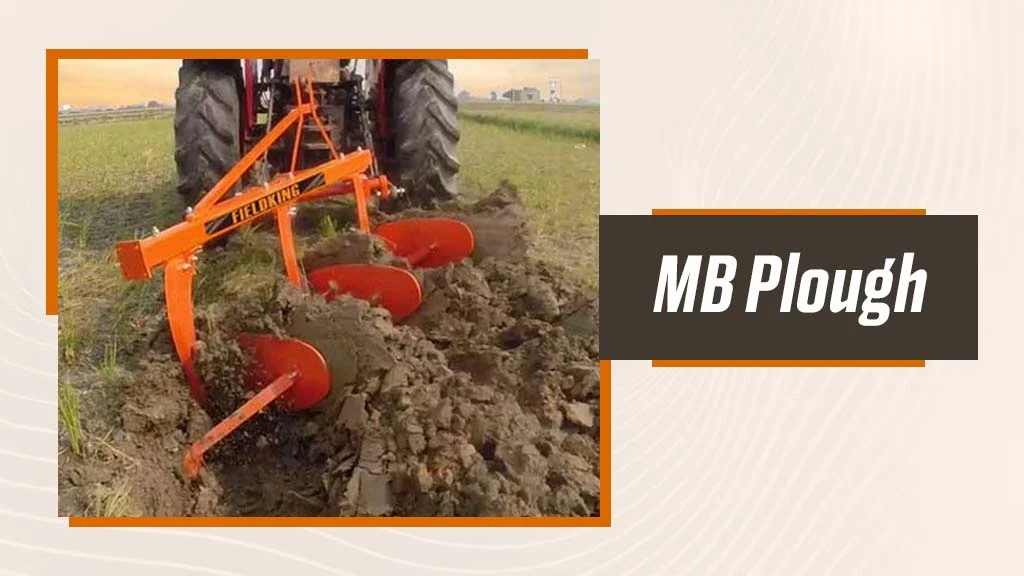
MB Plough is one of the traditional ploughs used in the agriculture sector. It is a primary tillage implement used to cut, lift, invert, and pulverize the furrow slice. In this type of plough, soil inversion occurs in only one direction as it throws the furrow slice to one side of the direction of travel.
The MB plough is used in the field, either by gathering or by casting. The popular MB plough brands in India are Fieldking MB plough, Landforce MB plough, Swan Agro MB plough, and many others.
Benefits – It is ideal for deep tillage and breaking through hard and compacted layers. It inverts the soil, helping control weeds.
Hydraulic Reversible MB Plough
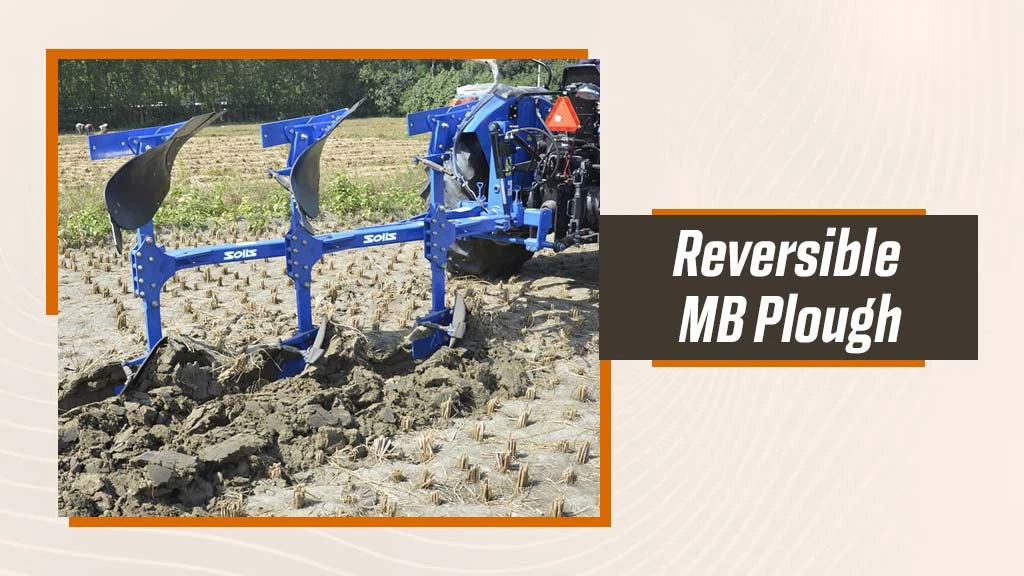
The hydraulic reversible MB plough is a more advanced type of MB plough, which is hydraulically operated for ploughing the land. It turns the furrow slice to the left or right, depending on the direction of travel, as needed. These ploughs consist of two sets of opposed bottoms.
In this plough, all furrows can be turned toward the same side of the field by using one bottom for one side of travel and the other bottom for the return trip. The popular hydraulic reversible MB plough brands in India are Shaktiman hydraulic reversible MB plough, Fieldking hydraulic reversible MB plough, Mahindra hydraulic reversible MB plough, and more.
Benefits – It can handle tough, compacted fields and works reliably across diverse soil types, from heavy clay to sandy loam.
Disc Plough
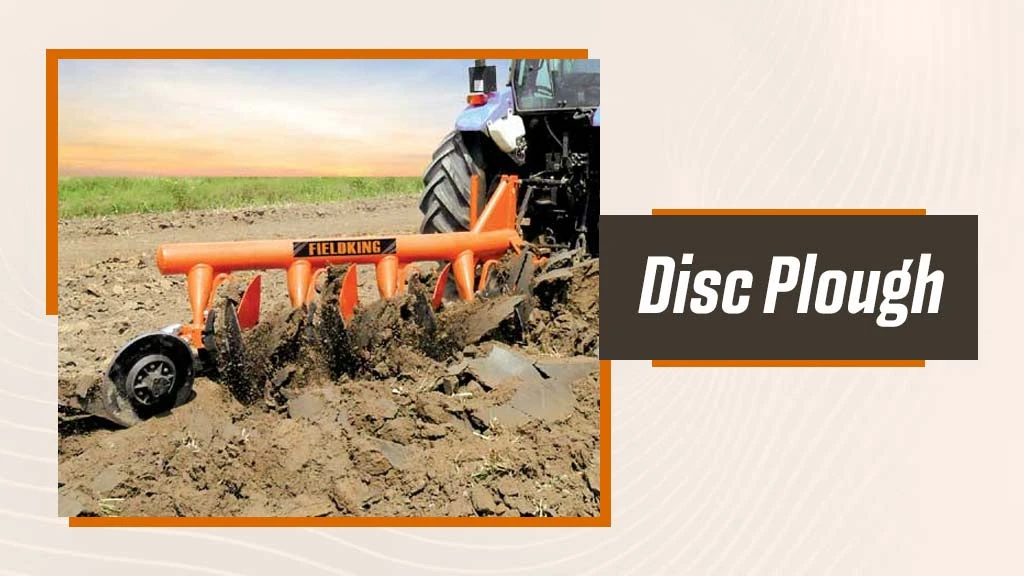
The disc plough is specially designed for hard, stony soil. It comes with a set of circular blades that cut through the soil and break the clumps easily. It is available in both fixed and reversible types. The common size of the disc is 60 cm in diameter. The popular brands offering disc ploughs in India are Fieldking disc plough, Landforce disc plough, Krishiking disc plough, and many others.
Benefits – This plough helps to break through hard soil layers easily and requires less power to operate on difficult terrains.
Chisel Plough
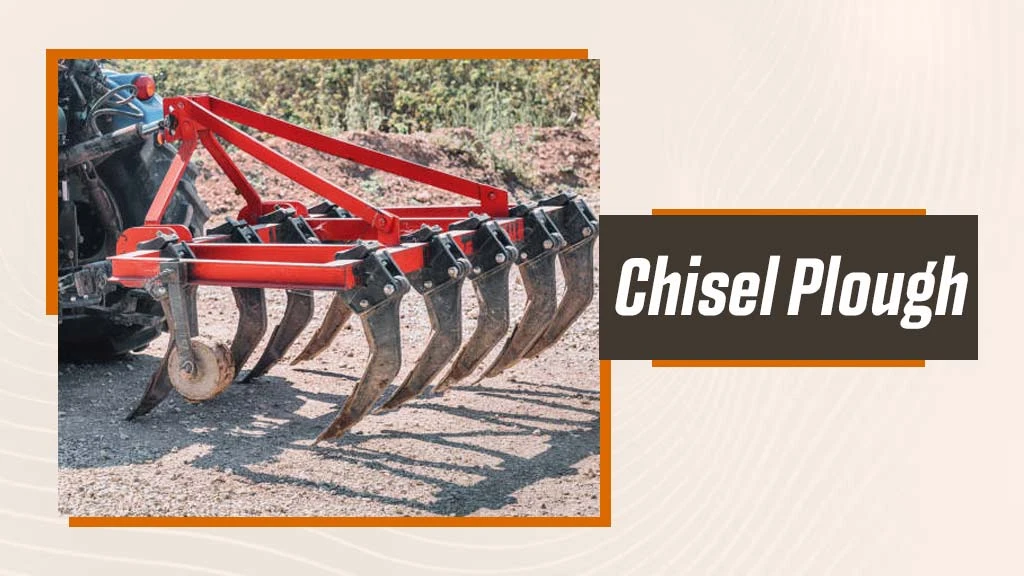
Chisel plough is designed especially for deep tillage, which causes less disturbance to the top layers. It ploughs the land to a depth of 60 to 70 cm. It has a thin frame with a sharp cutting blade. It does not turn the soil as much as other ploughs, which makes it a suitable option for low-tillage farming.
The chisel plough is suitable for ploughing hardpan soil. The popular chisel plough brands in India are John Deere chisel plough, Vishwakarma chisel plough, and Agrotis chisel plough.
Benefits – The chisel plough promotes deep root growth and water infiltration while minimizing soil erosion and reducing fuel costs.
Subsoiler
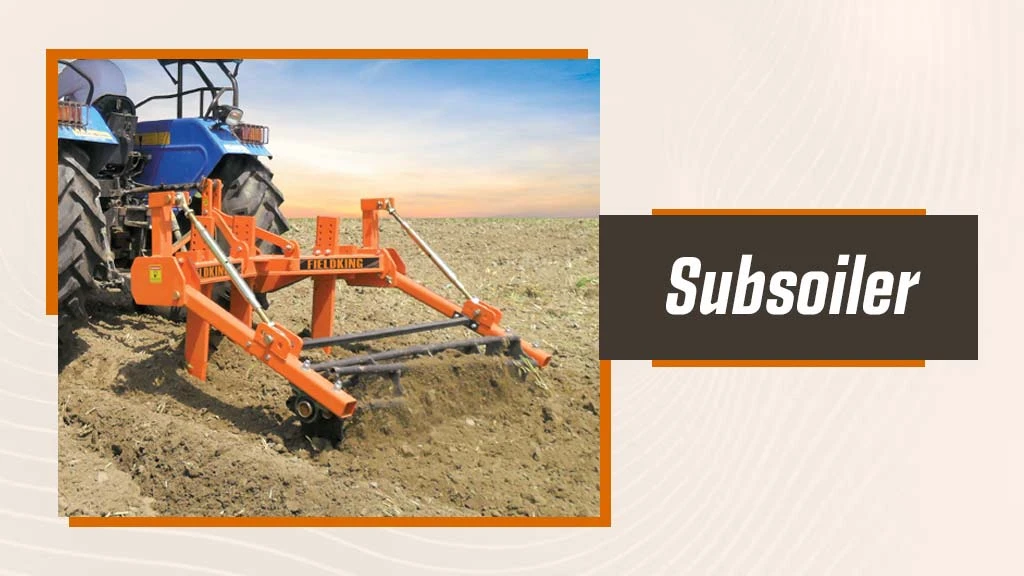
The shape of a Subsoiler is similar to a chisel plough, but it has stronger, heavy-duty legs for deep ploughing. It breaks the hard layers of soil or subsoil without bringing them up to the surface. It ploughs the land up to depths of two feet. The popular subsoiler brands in India are Fieldking subsoiler, Maschio Gaspardo subsoiler, Lancer subsoiler, etc.
Benefits – Subsoiler ploughs improve soil health, aeration, and structure while reducing waterlogging. It also helps plants access nutrients easily.
What are the Different Methods of Ploughing?
Ploughing is done mainly to obtain a deep seedbed which has good water retention and appropriate air. This can be achieved with four main methods of ploughing, such as gathering, casting, the continuous ploughing method, and the round and round ploughing method. Let’s discuss them below:
Gathering
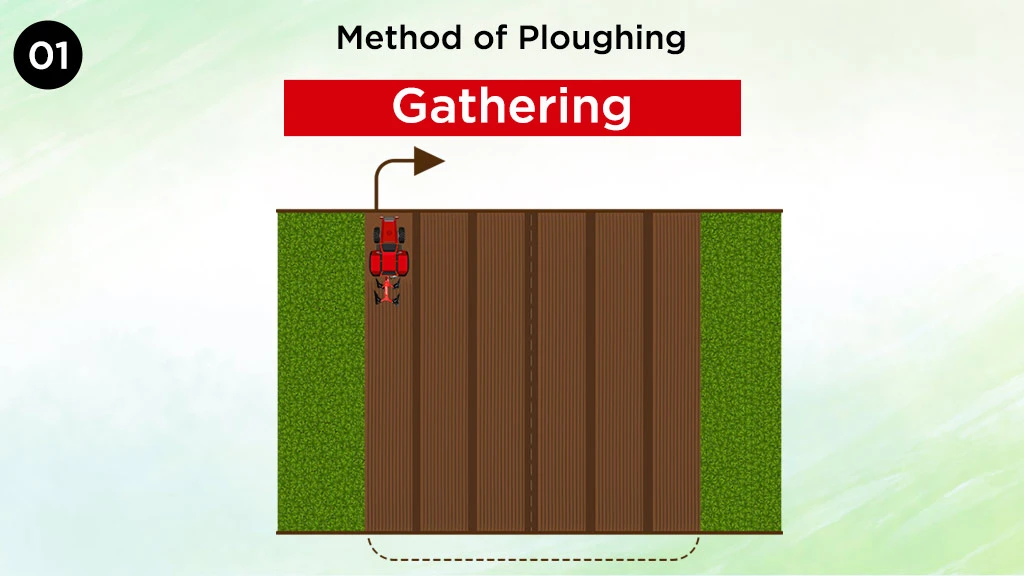
Gathering is a process in which the plough works round a strip of ploughed land.
Casting
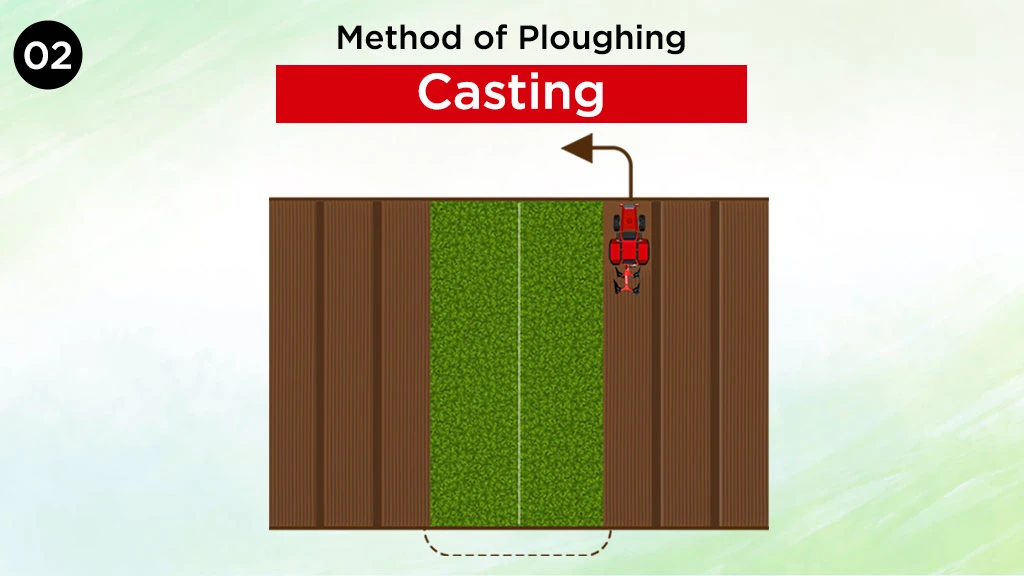
Casting is a process in which the plough works round a strip of unploughed land.
Continuous Ploughing Method
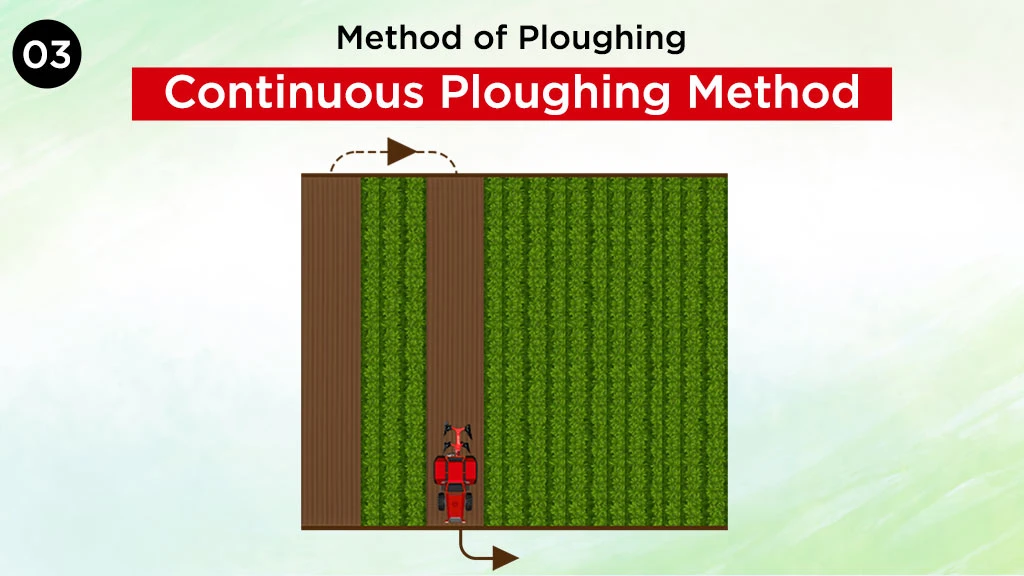
This ploughing method is one of the most economical and convenient methods. It is a traditional large-scale farming method that helps in quick seedbed preparation along with weed control.
In this process, the tractor and the plough never stay idle beyond three-quarters of the land width along the headland. They also do not move within a space narrower than one-quarter of the land width. Ploughing is done continuously without leaving large sections of furrows unploughed. This method is efficient in enhancing uniformity while ploughing.
Round and Round Ploughing Method
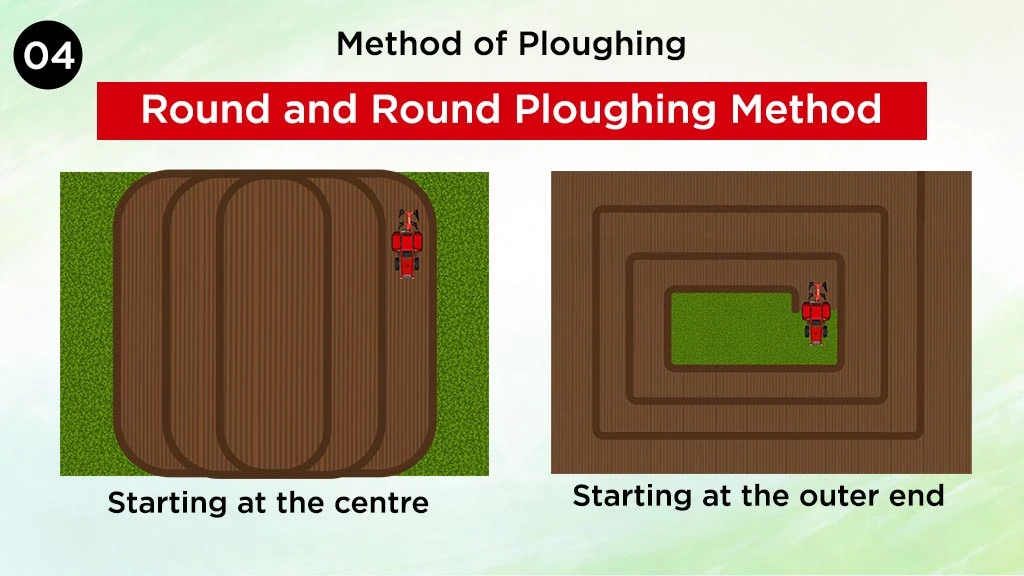
In this method, as the name suggests, the plough moves circularly in the field. The Ploughing starts from one side of the field, and gradually it reaches the centre. This method is not ideal as large diagonals remain unploughed.
What are the Tips for Choosing the Right Plough?
- Soil Analysis: Firstly, if you are considering investing in a plough, you need to understand the soil type of your land. Different soils and crops need different types of ploughs for tilling.
-
- Loamy soil requires an MB plough
- Stony soil is best suited for a disc plough.
Both the MB plough and the chisel plough is suitable for maize and wheat farming. At the same time, sugarcane might require a subsoiler.
- Tractor Compatibility: The higher the HP of your tractor, the better the ploughing performance. Choose a plough that is compatible with your tractor HP and hydraulics. This is because all these factors are responsible for operating the plough smoothly.
4WD tractors are better at providing stability and traction when it comes to handling implements like a plough. All these factors decide the compatibility of the plough with a tractor.
- Brand Reputation: It is important to choose your plough from a reputable brand that has a good dealer network. It should offer reliable service and readily available spare parts. Good customer support is a benefit as it can help you with any issues you may face with the plough.
- Budget and Cost: Look for any subsidies offered by the government on the plough that you want to purchase. If not, then you can always opt for an implement loan at the best interest rates.
- Demo: Make sure you take a demo of the plough before purchasing. It will give you a clear picture regarding its usage, specifically for your farm. You can also check out expert reviews and user reviews to understand whether it fits your requirements or not.
Which are the Popular Plough Models in India?
|
Model Name |
Implement Type |
Price (₹) |
|
Disc Plough |
75,923* |
|
|
Disc Plough |
62,187* |
|
|
MB Plough |
47,336* |
|
|
MB Plough |
32,497* |
|
|
Hydraulic Reversible MB Plough |
3,05,000* |
|
|
Hydraulic Reversible MB Plough |
2,16,200* |
|
|
Subsoiler |
80,000* |
|
|
Subsoiler |
1,60,000* |
Get Information on Different Types of Plough Online
Tractorkarvan is an online platform that provides comprehensive and authentic information on various types of ploughs in India. Here, you can find various models of MB ploughs, disc ploughs, hydraulic reversible MB ploughs, chisel ploughs, and subsoilers, along with their specifications and prices. We have a compare implements feature on our portal where you can compare two plough models from the same or different brands. You can explore our plough page, where you can find all types of plough listed with their complete specifications and prices.
Frequently Asked Questions On Ploughing in Agriculture
1. What is Ploughing?
Ploughing is the method of turning over and breaking up the soil using a plough or other farm implements to prepare it for planting.
2. What are some types of ploughs used in India?
Some types of ploughs used in India are the MB plough, the hydraulic reversible MB plough, the disc plough, the chisel plough, and the subsoiler.
3. Why is ploughing important?
Ploughing helps loosen the soil for proper aeration, as well as weed and pest control.
4. What are the different methods of ploughing?
The different methods of ploughing include gathering, casting, continuous ploughing, and round and round ploughing.






Related Blogs