A Step-By-Step Guide to Plum Farming in India


Plums are juicy fruits packed with rich vitamins and antioxidants. They come in different colors, ranging from deep purple and crimson red to bright yellow. In India, they are known as Aloo Bukhara and are a favorite summer delight due to their sweet & tangy taste. This blog explains everything about plum farming, including popular varieties and cultivation methods.
Table of Contents
- Plum Farming in India
- Why Plum Farming is Popular in India?
- Famous Plum Varieties in India
- Steps to Cultivate Plum in India
- State wise Production of Plum in India
- Summary
Plum Farming in India
Prunus salicina L. is the scientific name of plum. This juicy stone fruit is considered a high-value commercial crop in India. The government also promotes plums as they are rich in Vitamins A & C, contain natural antioxidants, and are perfect for making jams and juices.
Earlier, plums used to grow only in hilly areas like Himachal Pradesh, Jammu & Kashmir, and Uttarakhand. But now, farmers can also grow special varieties of plum in warmer plains of Punjab, Haryana, and Western Uttar Pradesh.
Why Plum Farming is Popular in India?
The reason why plum farming is so popular in India is because of the benefits it offers to the farmers. Some of these benefits include:
- Plum crops offer excellent returns and have lower initial investment when compared to other crops like apples.
- A well-managed plum orchard provides a steady income for many years.
- New varieties allow farmers in Punjab and Haryana to grow plums, not just hill stations.
- Plum trees can easily survive freezing winters and can also tolerate hot summer temperatures of India.
- Some plum varieties ripe early in April, so farmers can sell them early for more profit.
- Many food companies buy large amounts of plums to manufacture jams, juices, and syrups.
Popular Plum Varieties in India
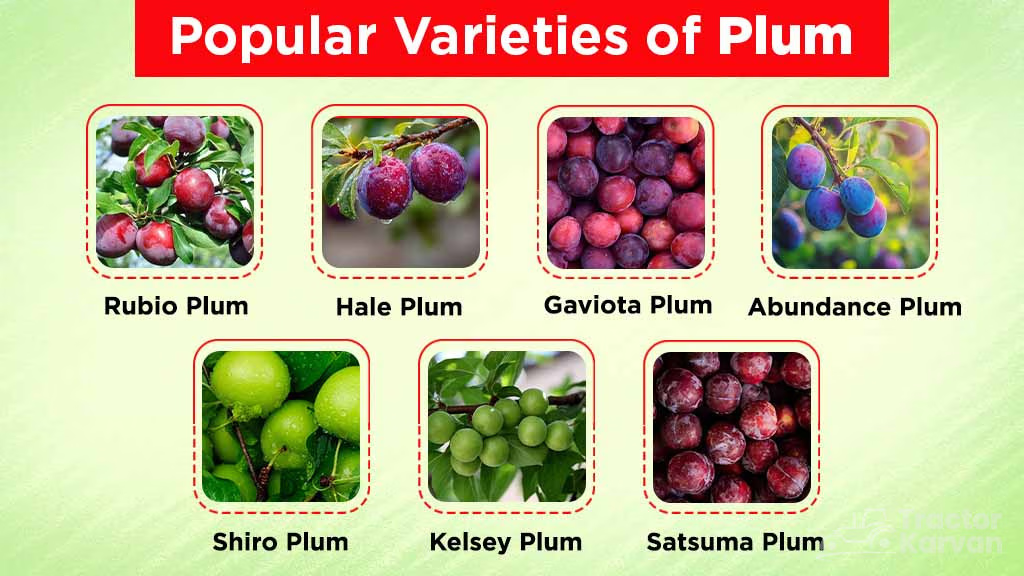
India has many different plum varieties, with some growing best in cold mountains and others in warmer plains. And below are some of the most popular plum varieties in India:
- Rubio
- Hale
- Gaviota
- Abundance
- Shiro
- Kelsey
- Satsuma
Steps to Cultivate Plum in India
Growing plums in India is a considered an excellent choice by farmers. It’s because they can provide massive yields and profits with low initial investment. And following are the steps involved in plum cultivation in India:
Soil and Climate
Plums can be cultivated above 1,200 meters of elevation in India. Also, plum trees grow best in red lateritic soil with good drainage. Moreover, it’s important to maintain a slightly acidic soil pH range between 5.8 and 6.2 to ensure the plants absorb nutrients effectively. Additionally, the soil should be rich in organic matter as it keeps the soil loose for healthy root growth.
Land Preparation
Dig pits that are 60 cm wide, 60 cm long, and 60 cm deep to plant plum trees. Space these pits 4 meters apart from each other on all sides in a straight square pattern. It is best to prepare your field and plant the saplings between June to November, choosing either early rainy season or early winter.
Plantation
Choose healthy one-year-old budded saplings to plant. Place them gently in the center of the pit, fill it back up with topsoil, and press down firmly around the base to remove any air pockets. After planting the saplings, water the pits right away to help soil settle tightly around the roots.
Fertilizer and Nutrient Management
Every October and November, provide each mature plum tree with 30 kg of farmyard manure (FYM), 500 grams of Nitrogen (N), and 1 kg each of Phosphorus (P) and Potassium (K) to ensure a healthy growth and a high fruit yield. Mix these fertilizers into the soil around the tree's drip line and water the area immediately. Doing this will help roots absorb nutrients better.
Training and Pruning
Cut the tops of young plum trees at 50 to 60 cm of height so side branches can grow out. This helps form an open, bowl-like shape that lets in plenty of sunlight and fresh air into the tree. And cut away dead, sick, tangled, and weak vertical branches every December or January to keep the trees healthy.
Pest Management
The biggest threat to plum orchards is the fruit flies, which causes severe damage by attacking the fruit pulp. To tackle this, farmers can mix either 2 ml of Malathion 50 EC or 1 ml of Fenthion 100 EC for each litre of water, then spray it on trees. Additionally, you can set up 1% Eugenol traps mixed with 1 ml of Malathion 50 EC per litre of water early in the morning between 6:00 AM and 8:00 AM.
Make traps using plastic bags containing 5 grams of wet fish meal and a cotton ball soaked in 1 ml of Dichlorvos. Set up 50 bait traps in total for every hectare of your land. And make sure to change the fish meal every 20 days and replace the Dichlorvos cotton balls every 7 days to keep the traps working.
Harvest and Yield
Depending on the specific variety chosen and the cultivation method followed, each mature plum tree can give an average yearly yield of 25 to 30 kg per tree. This ensures a steady source of income for farmers once the orchard reaches its mature stage. With adequate care, farmers can maximize this harvest and keep their trees healthy for longer.
State wise Production of Plum in India
Following are the top plum producing states in 2024-2025 along with their production quantity and percentage of market share.
|
State |
Production (in 000 tonnes) |
Share (%) |
|
Jammu And Kashmir |
18.96 |
27.63 |
|
Himachal Pradesh |
14.97 |
21.82 |
|
Uttarakhand |
11.79 |
17.18 |
|
Punjab |
11.53 |
16.8 |
|
Tamil Nadu |
5.7 |
8.31 |
|
Nagaland |
2.8 |
4.08 |
|
Madhya Pradesh |
1.68 |
2.45 |
|
Haryana |
0.78 |
1.14 |
|
Maharashtra |
0.15 |
0.22 |
|
Sikkim |
0.14 |
0.2 |
|
Manipur |
0.1 |
0.15 |
|
Ladakh |
0.01 |
0.01 |
|
Total |
68.61 |
|
Summary
Plum farming is a highly profitable business across both the mountains and warm plains of India. By choosing the right variety and following the right cultivation steps, farmers can secure higher yield and income. Ultimately, a well-maintained plum orchard acts as a reliable asset that provides higher yields and stable income in the long term. By following the methods mentioned above, farmers can maximize their results and ensure a healthy plum orchard.
Frequently Asked Questions On Plum Farming
1. Which state produces the highest number of plums in India?
Jammu And Kashmir produce the largest number of plums in India, holding about 27.63% of market share.
2. Which are the most popular plum varieties in India?
The most popular plum varieties in India are Rubio, Hale, Gaviota, Abundance, Shiro, Kelsey, Satsuma.
3. How much plum fruits does India produces annually?
As of 2024-2025, India has produced 68 thousand tonnes of plum fruits in total.
4. What soil conditions are required for plum farming?
Plums grow best in red lateritic soil that has a pH range between 5.8 and 6.2.






Related Blogs