Rural Transformation of Agriculture & Allied Sectors: The Indian Story


The Indian agriculture sector is longer defined by the plough alone. Over the last decade, the agriculture sector has diversified itself into dairies, fisheries, poultry farms, Farmer Producer Organizations (FPOs), etc. This shift is helping farmers move towards long-term productivity and better income.
Nearly 45% of the Indian population still depends on farming and related activities for a livelihood. So, it becomes important to understand rural transformation of agriculture and allied sectors. This blog will explain this transformation and the changing rural economy.
Table of Contents
- How is the Rural Economy Changing?
- Allied Sectors Pushing Rural Growth
- Factors Driving this Change
- Conclusion
How is the Rural Economy Changing?
Earlier agriculture meant growing crops like rice, wheat, sugarcane, cotton, etc. Currently, this is changing and it can be seen in Economic Survey 2025-26. According to the Economic Survey 2025-26, agricultural GVA (gross value added) expanded by 3.6% in the first half of FY26. This growth is better than the 2.7% recorded last year.
The major contributors to this growth are livestock and aquaculture. These two allied sectors are easily outpacing regular crop production. Similarly, other sectors like livestock, fisheries, etc., have also seen annual growth. Agriculture and allied activities together stand at 52,08,800 crores as per the Second Advance Estimates of Annual GDP for 2025-26. Within this total, the internal mix has shifted meaningfully as the share of crops fell down and livestock's share rose. This doesn't mean that crop farming is declining, but it simply shows how the allied sectors are slowly growing. This is the essence of rural transformation: diversification, not replacement.
Allied Sectors Pushing Rural Growth
Rural growth today is not just focused on single-crop farming. High value allied sectors like dairy, fisheries, horticulture, etc., have now become popular among farmers.
Dairy Sector
Nowhere is this diversification clearer than in dairy. The dairy sector employs almost 8 crore farmers and contributes about 5% to the national economy. India is world's largest milk producer, and it produced around 247.9 million tonnes of milk in 2024-25. The per-capita milk availability has increased from 319 grams/day in 2014-15 to 485 grams/day in 2024-25. Uttar Pradesh, Rajasthan, Madhya Pradesh, Gujarat, and Maharashtra together dominate milk production in India.
To learn about dairy business, read How to Start a Dairy Farm Business in India: A Beginners Guide.
Fisheries
Fisheries have grown at 8-9% annually and are projected to grow more with support from government schemes like Pradhan Mantri Matsya Sampada Yojna. It is estimated that fisheries will create around 8 lakh direct jobs in the next three years and will also increase export earnings by 2028.
You can read more on government schemes to promote fishing on our blog, Government Schemes to Promote Fish Farming in India 2026.
Horticulture
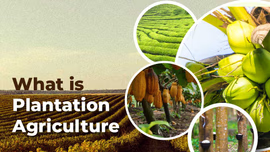
Approximately 33% of agricultural GVA is contributed by horticulture, and it employs around 5-7 lakh farmers. The government is promoting cultivation of high value crops like coconut, sandalwood, cocoa, cashew, agarwood, walnuts, pine nuts, etc. Also, plantation crops like tea, coffee, spices, etc., are also being pushed for increased export. For small farmers, diversification into horticulture and plantation crops has helped them increase their income and reduced their dependency on traditional cereals and crops.
Factors Driving this Change
Direct income support, Farmer Producer Organizations (FPOs), and women self-help groups are the top the three factors driving this transformation. Below, we have discussed them in detail:
Farmer Producer Organizations (FPOs)
A major part of Indian farmers owns less than 2 hectares of land. Such marginal farmers have very little individual bargaining power. For such farmers, the Central Sector Scheme for the Formation and Promotion of 10,000 FPOs was launched in 2020.
FPOs help small scale farmers by combining resources and reducing production costs. The farmers get direct market access to sell their produce to wholesalers or on digital platforms like e-NAM. FPOs also get discounts on purchase of seeds, pesticides, etc. Shared access to modern processing and packaging facilities help farmers turn their raw crops into higher value products like jams, dairy, etc.
Special government grants and financial assistance are given to registered FPOs to help the farmers buy expensive farm implements collectively. Also, the members get access to financial literacy, best agricultural practices, etc.
Direct Income Support
PM-KISAN is a government scheme that provides income support of ₹6000 per year to eligible farmers. This scheme has become one of the world's largest direct benefit transfer programs. The farmers can use this money to meet their farming needs. Farmers can apply for this scheme on the official PM-KISAN portal, and eligible farmers can check their instalment status also.
To learn more about government schemes for farmers, read Top 15 Central Government Schemes for Farmers in India 2026.
Women Self-Help Groups (SHGs)
Women self-help groups come under National Rural Livelihoods Mission and these SHGs usually consists of 10-20 local women. These women pool savings to access micro-credit, launch agricultural micro-enterprises, and receive training. Also, many SHGs are directly linked to allied-sector livelihoods like dairy, poultry, horticulture, etc. Key government and support programs for SHGs include MKSP (Mahila Kisan Sashaktikaran Pariyojna), Krishi Sakhi, etc.
Conclusion
Agriculture in India is changing step by step, through FPOs and self-help groups across different sectors. Currently, the focus has moved beyond farming to a wider rural economy that includes livestock, fisheries, horticulture, etc. Now it is important to keep this progress going and making sure rural transformation of agriculture and allied sectors benefit small and marginal farmers.
Frequently Asked Questions On Rural Transformation of Agriculture & Allied Sectors
1. What is rural transformation in the context of Indian agriculture?
Rural transformation refers to the shift from farming being narrowly focused on crops to a broader rural economy that includes allied sectors like dairy, fisheries, and horticulture.
2. Which allied sectors are driving rural growth in India?
Dairy, fisheries, and horticulture are the top allied sectors pushing rural growth.
3. How do Farmer Producer Organizations (FPOs) help small farmers?
FPOs help small and marginal farmers by combining resources, reducing production costs, and providing direct market access through platforms like e-NAM.
4. What is PM-KISAN and how does it support farmers?
PM-KISAN is a government scheme that provides ₹6000 per year in direct income support to eligible farmers.




Related Blogs