Apple Farming in India: How to Cultivate and Top Varieties


Apple is among the most popular fruits, widely produced across the world. The popular apple varieties are Red Delicious, Golden Delicious, McIntosh, Chaubattia Anupam, and Lal Ambri. Jammu & Kashmir is the largest Apple producing state in India, followed by Himachal Pradesh and Uttarakhand. Today’s blog explores the top apple varieties found in India, along with their cultivation process and major producing states.
Table of Contents
- Status of Apple Farming in India
- What are the Popular Types of Apples in India?
- Which are the Major Apple Producing States in India?
- How to Grow Apple Successfully?
- Scope of Apple Cultivation in India
Status of Apple Farming in India
Apple is one of the most popular temperate fruits and among the most produced fruits worldwide. Its scientific name is Malus pumila. China is the world's largest producer of apples. India is among the top ten apple-producing countries globally. In 2023-24, the total apple production was 2,625,900 metric tons in India. According to the US Department of Agriculture, India ranks fifth in apple production, contributing 3% to global production. The total area under cultivation for apples in India is around 2.50 lakh hectares. Moreover, India is a significant player in the global apple export market. Overall, apple is an important fruit for Indian farmers, being a high-value crop with potential for high returns.
What are the Popular Types of Apples in India?
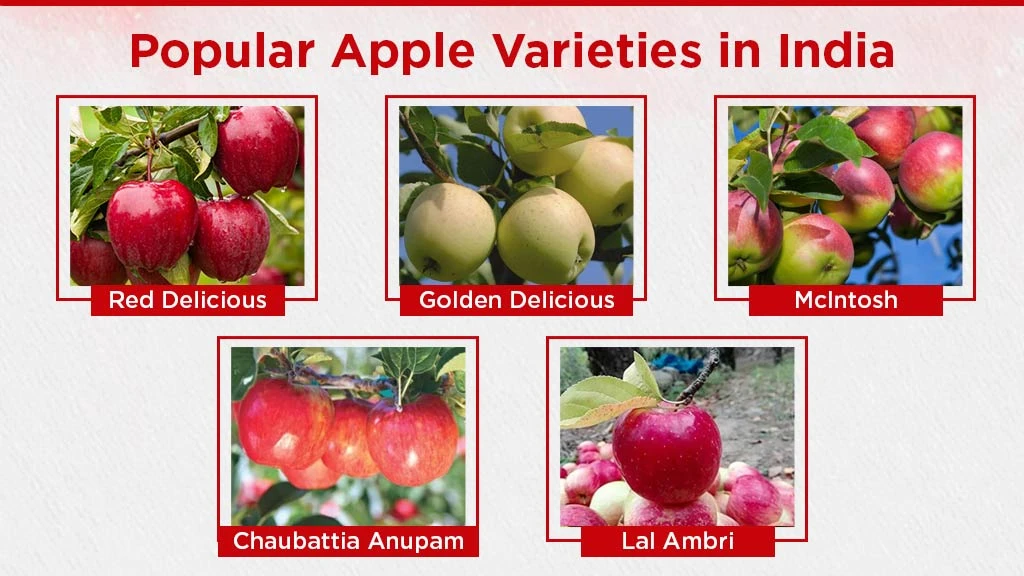
- Red Delicious: Red Delicious is one of India's widely cultivated apple species, growing in different regions of Himachal Pradesh. This apple has a red exterior and a sweet, yet mild flavor. Its flesh is juicy and has a light crispness. It is available throughout the year and is primarily grown for table purposes.
- Golden Delicious: Golden Delicious is a large-sized and yellowish-green-skinned cultivar. This variety is widely grown in the Jammu & Kashmir and Himachal Pradesh regions. It is a preferred variety for table and processing purposes. It is prone to bruising and shrivelling and requires careful handling and storage. This variety is widely used in salads, apple butter, and apple sauces.
- Mclntosh: The McIntosh apple variety is a medium-sized fruit with an attractive dark red or crimson colour. It generally tastes sweet but with refreshing acidity and a hint of wine, which is why it is also called "vinous." This variety is widely grown in the Himachal Pradesh and Uttar Pradesh areas.
- Chaubattia Anupam: The Chaubattia Anupam variety is also a medium-sized fruit with a shiny yellow colour and red stripes. The fruits of this variety have crisp, white flesh and a sweet taste. It is widely grown in the regions of Uttar Pradesh.
- Lal Ambri: The Lal Ambri variety is developed from the cross between Red Delicious and Ambri. It has smooth skin and is available in a bright-dark red colour. Its pulp is creamy white and features a mild, sweet, and juicy taste. This variety is widely cultivated in the Kashmir valley.
Which are the Major Apple Producing States in India?
As per the data published by National Horticulture Board (NHB), the top apple producing states in India are Jammu & Kashmir, Himachal Pradesh, Uttarakhand, Arunachal Pradesh, Ladakh, and Nagaland. Let’s discuss their production and percentage share in the table below:
|
State |
Production in (000) tons |
% Share |
|
Jammu & Kashmir |
2,064.30 |
78.61 |
|
Himachal Pradesh |
506.69 |
19.30 |
|
Uttarakhand |
42.97 |
1.64 |
|
Arunachal Pradesh |
6.79 |
0.26 |
|
Ladakh |
3.22 |
0.12 |
|
Nagaland |
1.77 |
0.07 |
How to Grow Apple Successfully?
The cultivation of apples involves different stages. Let's discuss each stage one by one:
Soil & Climate
Apple cultivation requires loamy soils with a pH value of 5.5 to 6.5. The soil should be rich in organic matter and have proper drainage and aeration.
Apples are grown in the Himalayan regions at altitudes ranging from 1500 to 2700 meters above sea level. The ideal temperature during the growing season should be around 21 to 24° C, and the region should receive an annual rainfall of 100 to 125 cm.
Planting
The ideal plantation time for apple plants is from January to February. Apple plants are propagated using the grafting method.
The average number of grafts in an area of one hectare can range between 200 and 1250. The spacing is divided into four categories: low (less than 250 grafts/ha), moderate (250-500 grafts/ha), high (500-1250 grafts/ha), and ultra-high density (more than 1250 grafts/ha).
Planting is usually done in square or hexagonal systems in the valleys, where the contour method is generally applied on the slopes.
Fertilizer Management
Farmyard Manure in a quantity of 10 kg per year (based on the age of the tree) should be provided, along with other fertilizers. The N, P, and K ratio of 70:35:70 grams/year (age of the tree) should be provided in an orchard of optimal fertility. The dose should be stabilized at 700:350:700 grams after 10 years of age.
In the "off" years, when the crop load is low, the N, P, and K fertilizer doses should be 500 grams, 250 grams, and 400 grams, respectively.
Irrigation
Apple cultivation requires at least 114 cm of water per annum, which can be supplied through 15 to 20 irrigations. During the summer, irrigation should be provided every 7 to 10 days, whereas during the winter, it should be provided every 3 to 4 weeks.
During the critical phase, which is from April to August, at least eight irrigations should be provided.
Training & Pruning
Training and pruning should be done in a timely manner to promote better growth and productivity. The plants should be trained according to the growth habitat and vigour of the rootstocks. The trees are trained on a modified central leader system, which provides the plant with proper exposure to sunlight. This enhances the fruit colour and reduces the effect of heavy snowfall and hail.
Pruning is important as it helps maintain a proper balance between spur development and vegetative growth. Pruning of weak and undesirable branches is required after six years of plantation.
Intercultural Operations
- Weeding: Glyphosate or Gammaxone /Paraquat can be used as a post-emergence herbicide to control weed growth for 4 to 5 months.
- Mulching: Mulching with hay or black alkathene can help control weeds in cool conditions and conserve moisture. Using oak leaves or dry grass can also help prevent soil moisture loss.
- Intercropping: Cultivating green manure crops, such as sunflowers and beans, is recommended in the early years of the plantation, as they can help improve the soil's nutrient status and enhance its texture.
The use of growth hormones can help in good flowering and proper coloration in fruits.
Harvesting & Yield
The economic life of an apple tree is more than 30 years. The orchard starts bearing fruit during the eighth year of the plantation. Productivity continues to increase from the 8th to the 17th year and then remains constant for 30 years. Apple is a climacteric fruit whose maturity period does not overlap with ripening. Apples usually get harvested before they are fully ripe.
Post-Harvest Management
The post-harvesting of apples is done in three stages: pre-cooling, grading, and storage.
Once the harvesting is done, the fruits are kept in a ventilated and cool place to remove the field heat. The fruit surface must be moisture-free before the grading process.
Grading is done based on the fruit size, appearance, and quality. They are manually graded in 6 grades based on fruit size and three or more quality grades based on shape, colour, appearance, and quality.
After grading, apples are stored in an ideal cool and dry storage. They have a longer storage life than other fruits and can be stored for 4 to 8 months after harvesting. Apples can be stored in cold storage at a temperature of around 1.1° C - 0° C and a humidity level of 85 - 90%.
Scope of Apple Cultivation in India
Apple cultivation is a highly profitable horticultural business in India. Farmers are adopting high-density planting methods and improved varieties to meet the growing domestic demand and capitalize on export potential. The rising demand is driven by major factors such as a growing health-conscious population, increasing disposable incomes, and urbanization. This is why India is also a major importer of apples. Thus, there is a huge supply gap of premium apple varieties that needs to be filled to meet domestic demand. The apple cultivation sector in India is projected to grow tremendously with continued innovation, addressing climate vulnerabilities, and infrastructure development.
Frequently Asked Questions On Apple Farming in India: How to Cultivate and Top Varieties
1. Which state is the largest producer of apples in India?
Jammu & Kashmir is the largest producer of apples in India, with more than 75% share.
2. How many types of apples are there?
There are five major types of apples: Red Delicious, Golden Delicious, McIntosh, Chaubattia Anupam, and Lal Ambri.
3. What type of fruit is an apple?
Apple is a pome fruit.
4. Which type of apple is best?
As per the Journal of Agriculture and Food Chemistry, Red Delicious is the best type of apple.
5. What are the benefits of apples?
Apple has significant export potential, as well as numerous health benefits. This fruit is a good source of antioxidants, Vitamin C, and fiber.






Related Blogs