Know Everything About Trem IV Tractors and CRDI technology


Common Rail Direct Injection (CRDI) engines are one of the latest advancements in the Indian tractor industry. Simply put, this technology ensures that fuel is delivered to the engine at the right time and in the right amount, which helps improve performance, increase fuel efficiency, and reduce emissions.
To meet the Trem IV emission norms, the Indian government has made it mandatory for tractors above 50 HP to be equipped with CRDI engines. In this blog, we’ll take a closer look at how CRDI engines work, along with their key advantages and disadvantages.
Table of Contents
- Getting Started with CRDI Technology
- What is CRDI Technology?
- How does a CRDI Engine work?
- What are the Advantages of CRDI Engine in Tractors?
- What are the Disadvantages of CRDI Engines in Tractors?
- What is the Future of CRDI Tractors in India?
- What are the Top Tractor Models in India with CRDI Engines?
Getting Started with CRDI Technology
Let’s take a step back and think about how automotive engineering has been evolving. It’s always been about finding that sweet spot between better fuel efficiency, stronger engine performance, and keeping emissions in check. And this is exactly where Common Rail Direct Injection or CRDI technology comes in as a real game changer. It has completely redefined how diesel engines work, helping them perform better while also reducing their impact on the environment.
Now, if we talk specifically about tractors, CRDI engines are actually a big step toward something even bigger; that is carbon neutrality on a global scale. That’s a pretty important shift, especially for a sector like agriculture.
You might also notice that different tractor brands call this technology by different names. For instance, John Deere refers to it as High Pressure Common Rail or HPCR technology. Farmtrac calls it e-CRT, and Sonalika uses the term CRDS for its CRDI tractors. But at the end of the day, they are all based on the same CRDI concept, just presented a little differently by each brand.
What is CRDI Technology?
First, let’s clear up a common misconception about CRDI technology. A CRDI engine doesn’t mean a completely new type of engine. It simply refers to a fuel injection system that uses multiple sensors and an ECU to deliver fuel to the cylinders.
In this system, a common rail supplies fuel to the injectors at high pressure. The ECU then controls the ideal timing and duration of fuel injection, which helps achieve improved fuel efficiency and lower emissions.
Contrary to older diesel engines, a CRDI engine has a high-pressure fuel pump. The main components of a CRDI engine are:
- Common rail
- Electronic Control Unit (ECU)
- Injectors
In the 1960s, Robert Huber developed the common rail system prototype. With further developments, common rail diesel engines were perfected for road vehicles. In 1995, Japan became the first country to manufacture heavy-duty trucks with the common rail on a large scale. Today, CRDI technology is available for all kinds of vehicles, ranging from passenger cars to farm tractors.
How does a CRDI Engine work?
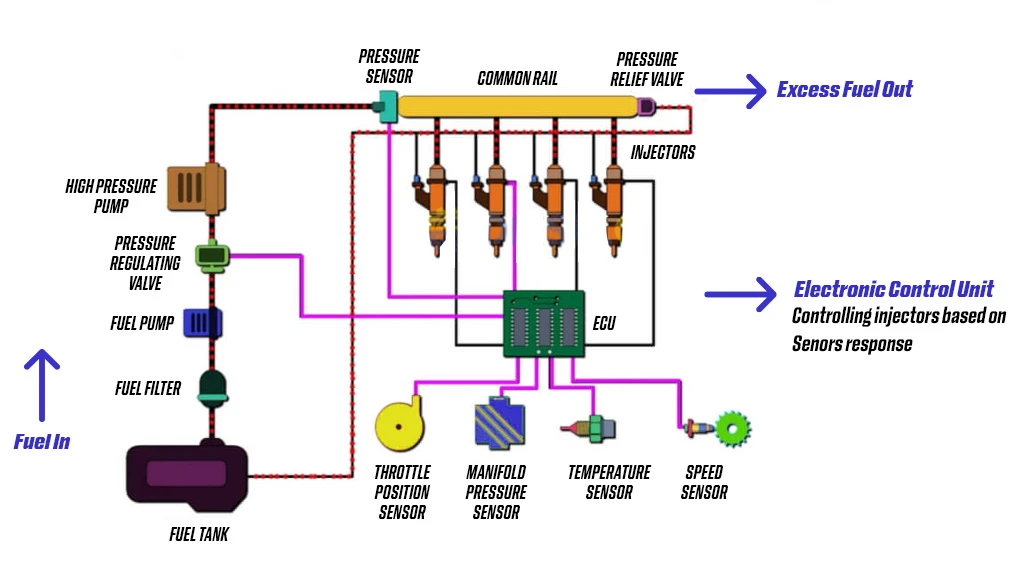
The function of a CRDI engine can be broken down into three key steps:
Common Rail - Fuel Collection
As mentioned before, CRDI technology offers a high-pressure fuel injection system. This fuel pump moves fuel from the fuel tank to be stored in the common rail under high pressure ranging from 1000 – 2500 bar. The common rail can be considered a distribution system for pressurized fuel. It maintains constant fuel pressure and optimizes injection accuracy as well as engine performance. The function of ECU comes in only when fuel is in the common rail.
Precise & Dynamic Fuel Injection
The ideal amount of fuel required by the engine cylinders depends on a wide range of parameters. It is important to consider the engine load and torque to derive the correct amount of fuel to be supplied to combustion chambers. ECU obtains data from different engine sensors to calculate the precise amount of fuel required inside the cylinder. Thus, the ECU is the brain of the CRDI engine that controls the fuel flow into the chamber. As the common rail keeps pressurized fuel, the cylinder receives small droplets of fuel.
Efficient Combustion
The fuel injectors deliver a precise amount of fuel in the form of droplets to the combustion chamber. These fuel droplets mix well with the air and cause optimized combustion. In older diesel engines, the performance would highly depend on the fuel-air ratio as they work with bigger fuel droplets. This is why they faced issues like high noise levels and inconsistent power delivery. CRDI engines have better, more efficient combustion that ensures better overall performance.
What are the Advantages of CRDI Engine in Tractors?
There are several reasons to switch to CRDI engines. The following are the main advantages of CRDI technology over conventional diesel engines:
- Improved Performance: The precise and timely delivery of fuel in CRDI engines improves engine responsiveness and power output. As they deal with refined fuel spray, these engines deliver consistent power delivery.
- Better Fuel Efficiency: CRDI engines use different sensors to deliver only the necessary amount of fuel to the chamber. Thus, there is no fuel wastage, which leads to ideal fuel consumption. Better management of fuel injection and steady power delivery results in better fuel efficiency.
- Engine Refinement: CRDI technology improves the noise, vibration, and harshness (NVH) of the tractor. The engine runs smoother and quieter. This is mainly because of controlled injection on time. These engines use a finer fuel spray, which burns efficiently.
- Reduced Emissions: CRDI engines are a boon for the environment. Due to the unoptimized use of fuel in older engines, these tractors produce a lot of black smoke. It is harmful to the health of both the environment and people. Thus, CRDI tractors produce fewer emissions, which is valuable for the healthy future of the planet.
- Engine Durability: The engine life of CRDI tractors increases because controlled fuel injection does not put excessive stress on its components. A stable fuel spray enhances engine refinement, which leads to smoother operation. Additionally, the engine tends to experience less wear and tears. Thus, CRDI engines have better durability than traditional diesel engines.
What are the Disadvantages of CRDI Engines in Tractors?
Even with several benefits, CRDI engines are not perfect. Here, we have listed some key demerits of using CRDI engines in tractors:
- Higher Cost: A CRDI engine is costly for both the manufacturer and the customer. It uses more parts than conventional diesel engines. In addition, they require advanced components like pressure sensors and computer chips. This is why CRDI engines are expensive to manufacture. Also, a costlier engine will result in a costlier tractor, which is not ideal for customers.
- Complicated Construction: A CRDI engine is an advanced piece of machinery. Thus, maintaining and repairing it is challenging. Only authorized and skilled workers can diagnose and resolve the issue in case of any fault. This becomes troublesome if a farmer is working in a remote location. Also, their repair is costly because of their expensive components.
- Limited Operations: As CRDI engines use electrical components, they are susceptible to damage from water. Thus, these tractors are not recommended for operations in water-filled fields. CRDI engines are also sensitive to the quality of fuel. So, uncontaminated fuel can easily result in major issues in the engine.
Farmers can choose to buy a CRDI tractor, considering the merits and demerits of CRDI engines. However, if you are interested in a tractor with a power output of more than 50 HP, you will have to buy a CRDI tractor. This is because CRDI engines are mandatory for more than 50 HP tractors to meet the Bharat Stage TREM IV standards set by the Indian government.
What is the Future of CRDI Tractors in India?
CRDI tractors are truly a big step forward for the Indian farming sector. They come with several advantages compared to traditional diesel engines, such as better performance, improved fuel efficiency, and lower emissions. While non-CRDI engines will still be available in tractors, adopting CRDI technology makes sense if you want to stay technologically up to date.
At the same time, it’s also important to meet the Trem IV emission standards to help control environmental pollution. On top of that, farmers can clearly benefit from CRDI tractors, as they offer better fuel efficiency and greater reliability, making day-to-day farming operations smoother and more cost-effective.
What are the Top Tractor Models in India with CRDI Engines?
Here are some top tractors in India that feature CRDI engines:
|
Model Name |
Tractor Power (HP) |
|
65 |
|
|
63 |
|
|
60 |
|
|
57 |
|
|
55 |
If you need more information about CRDI tractors, you can check out the Top 10 Trem IV Tractors for farming in India. You can also check out a wide range of CRDI tractors on Tractorkarvan, including their prices, key specifications, and features. Choose a suitable model and boost your productivity and efficiency right away.
Frequently Asked Questions On Know Everything About Trem IV Tractors and CRDI Technology
1. What is CRDI technology in tractors?
CRDI is a fuel injection system that uses a common rail and ECU to deliver fuel at the right pressure, timing, and quantity for better performance and efficiency.
2. Why are CRDI engines needed for Trem IV norms?
They help reduce emissions by ensuring cleaner combustion, which is required to meet Trem IV standards.
3. Are CRDI tractors more fuel efficient?
Yes, they use precise fuel injection, which reduces wastage and improves overall fuel efficiency.
4. What are the drawbacks of CRDI tractors?
They are more expensive, require skilled maintenance, and depend on good quality fuel.
5. Is CRDI mandatory in India?
Yes, for tractors above 50 HP, CRDI engines are required to comply with Trem IV emission norms.






Related Blogs