History of Tractors in India: Origin, Evolution and Modern Era


Ever wondered how Indian farming transformed from bullock-driven fields to powerful machines shaping modern agriculture? Tractors have become the backbone of India’s agricultural progress, playing a crucial role in increasing productivity and efficiency. From carrying heavy loads to performing multiple farming operations, these machines have revolutionized how farming is done in the country. Earlier, bullock carts were widely used to carry heavy loads, but tractors gradually became the preferred choice for many farming and transport activities. Since 1961, the Indian tractor industry has grown steadily. Innovation and technology in the field of agriculture have improved food security and helped reduce food prices worldwide. In today’s blog, we will understand the history of the tractor along with its origin, evolution, and modern era.
Table of Contents
- Origin of Tractors
- India’s Scenario in the Development of Tractors
- Tractor Scenario from 1997 to 2015
- Modern Era of Tractors
- Tractor Sales of India
- Future of the Indian Tractor Industry
Origin of Tractors
The first appearance of the tractor was seen in the late 19th century. It was a heavy steam-powered iron tractor. In 1892, John Froehlich developed the first farm vehicle powered by a petrol engine. Although the tractor was technically successful, it did not achieve commercial success at that time. Later, tractors were used with implements like ploughs, which improved their usefulness and adoption. Farmall was the first multi-functional tractor capable of ploughing, cultivating, spreading, and threshing. The Garrett 4CD was the most famous steam tractor for road haulage.
The development of the tractor industry has gone through many variations. Gasoline-powered tractors were introduced. In the year 1930, new inventions were introduced in the tractor industry; Harry Ferguson introduced the hydraulically controlled 3D hitching system for implements, called the Ferguson system. Later, Ferguson and Massey-Harris made Massey-Harris-Ferguson, and then the company's name was shortened to Massey Ferguson. In 1991, Fiat owned Ford-New-Holland and renamed it New Holland in 1993.
India’s Scenario in the Development of Tractors
The tractor industry was included as the “core sector” in India’s economic development in 1951. As a result, its growth and development policies were periodically reviewed on a plan-to-plan basis. Let us now examine the various stages of growth in India’s tractor industry.
Tractor Industry: 1961 -70
Tractor manufacturing in India started in 1961. The mechanization of agriculture was promoted by encouraging the local manufacturing of tractors. After four leaders in the market, Mahindra was the fifth market leader to be licensed with a capacity to manufacture 11,000 tractors. The production rate was slow at that time, so the government decided to invite additional market leaders into tractor manufacturing in 1968. The number of tractors in India grew significantly during the 1960s. It increased from around 37,000 in 1960 to more than 1,46,000 tractors by 1970.
Tractor Industry: 1971-80
Tractor demand increased significantly in 1971 due to the green revolution. 6 units established their manufacturing facilities, of which Escorts established Escort Tractors Limited and collaborated with Ford, U.K., and started manufacturing Ford tractors. Some tractor manufacturers could not survive and shut down their plants. After that, the government of India started promoting indigenous manufacturing to local tractor leaders in the country. Farmers were provided with loans to boost the overall sector. The market flourished in 1973 when more manufacturers started participating. The tractor industry started expanding rapidly in 1977. A total of 33,000 units in 1975 increased to over 71,000 units in 1980. The total number of tractors that were in use was more than 5,00,000 units.
Tractor Industry: 1981-90
In this period, the tractor industry experienced rapid growth. Five more units were set up for manufacturing tractors. The tractor manufacturers were manufacturing all the tractors indigenously. There was an increase in the production rate of tractors in the post-1980s period. However, some companies could not survive and shut down their plants, except VST Tillers and Tractors. The Working Group in the Ministry of Industry and, later on, a Group in the Ministry of Agriculture recommended improving fuel efficiency and power take-off shafts in the tractors. The tractor industry produced 75,000 tractors in 1985 and almost 1,40,000 tractors in 1990. The number of tractors in use was 1.2 million units in 1990. India became an exporter after this period.
Tractor Industry: 1991-98
During the nineties, there was a huge change in the tractor industry. The tractor manufacturers were able to receive industrial licenses and government approval in 1992. The international companies also participated in the production of tractors in India. However, imports of fully built tractors were restricted at that time. Farmers were taking advantage of loans like in previous years. Escorts started to produce Farmtrac tractors after its collaboration ended with Ford. Bajaj Tempo started manufacturing tractors in 1997 and International Tractors (Sonalika) commenced operations in 1998. A total of 2,55,000 units were produced during 1997. The total number of tractors in use was over two million units.
Tractor Scenario from 1997 to 2015
The period from 1997 to 2015 was remarkable in the history of tractors. Five more tractor manufacturers joined in the production of tractors in India. Bajaj Tempo set up its plant in Pune in 1998. Later, they changed their name to Force Motors. Larsen and Toubro started manufacturing 35-65 HP tractors with John Deere in Pune, Maharashtra. Also, New Holland started manufacturing 70 HP tractors in Greater Noida, U.P. and had an annual capacity of manufacturing 35,000 units. Greaves Ltd. also joined hands with Deutz-Fahr of Italy. In 1999, Bharat Trem I emission norms were started in October. Later, in 2003-2011, Bharat Trem II and Bharat Trem III and Trem IIIA emission norms were implemented. In 2013, India accounted for 29% of global tractor production, and its production reached 6,19,000.
Modern Era of Tractors
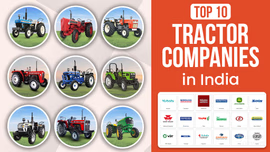
As we have seen the time period of the tractor industry so far, it is time to discuss some facts about the modern era of tractors. Today, India is one of the biggest tractor industry markets in the world and accounts for one-third of total global tractor production. It has the most popular tractor manufacturers, such as Mahindra, Swaraj, Sonalika, John Deere, Escorts, etc.
For decades, Mahindra has been the largest tractor manufacturer and has the highest production in the country. They have manufacturing facilities across 8 countries around the globe. Swaraj is another market leader. With a cumulative sale of 5,00,000 Swaraj tractors; it achieved its first milestone in 2002. Then Mahindra acquired the brand in 2007. TAFE (Tractors and Farm Equipment) Limited is one of the major brands in the tractor industry which was established in 1960 at Chennai, India. It is the second-largest tractor manufacturers by volumes in India.
Now, the tractor industry has been transforming in many ways. Sonalika created history by launching India’s first electric tractor to boost the economy and make it a more technologically advanced country. Mahindra has come up with a CNG tractor in Central India's largest Agri Summit at Nagpur in the presence of Shri. Nitin Gadkari, the Honorable Minister of Road Transport & Highways, Government of India. A CNG tractor reduces emissions by nearly 70% compared to diesel tractors. Then, the Solis tractors company was launched, a sister company of Sonalika.
In 2020, VST Tillers Tractors signed a Memorandum of Understanding (MoU) with Zetor Tractors for the joint development of products, which are sold through VST channel partners in India and Zetor channel partners in the international market. Bharat Trem IV emission norms became applicable for more than 50 HP tractors in 2023.
With advancements such as electric tractors, CNG-powered models, precision farming technologies, and stricter emission standards, the sector is evolving rapidly. Continued investments by leading manufacturers and collaborations with global companies enhance product quality and efficiency. These developments are expected to further strengthen India's position as a global leader in the tractor industry.
Tractor Sales of India
Over the years, the tractor industry has experienced steady growth, reflecting the increasing pace of farm mechanization across India. This upward trend highlights how farmers are adopting modern equipment to improve productivity and efficiency. Below, we present a comprehensive overview of brand-wise sales and market share for your reference.
|
Brand |
Sales FY’26 |
Market Share (%) |
|
Mahindra & Mahindra (Tractor) |
2,49,973 |
23.81% |
|
Mahindra & Mahindra (Swaraj Division) |
1,96,975 |
18.76% |
|
International Tractors Ltd. |
1,34,030 |
12.76% |
|
TAFE Ltd. |
1,18,326 |
11.27% |
|
Escorts Kubota Ltd. |
1,14,468 |
10.90% |
|
John Deere India |
80,086 |
7.63% |
|
Eicher Tractors |
65,215 |
6.21% |
|
CNH Industrial India (New Holland) |
47,122 |
4.49% |
|
Others |
43,882 |
4.18% |
|
Total |
1,050,077 |
100% |
Future of the Indian Tractor Industry
The Indian tractor industry is now well-established and flourishing. We can expect more innovations and advancements in the coming years. Tractors with AC cabins that comply with the latest emission norms have already been introduced. Now, we can expect more autonomous tractors that can operate autonomously. Tractors with motion detection sensors, climate-controlled cabins, Internet connectivity, and many more features will increase farm productivity and save farmers’ time.
The government should come up with more credit schemes, subsidies, and initiatives to help farmers financially. Moreover, if you want to know more about tractors and implements, check out Tractorkarvan. Here, you can learn about tractors, implements, and tractor-related blogs for a better understanding. The future of the Indian tractor industry lies in innovation, sustainability, and farm mechanization.
Frequently Asked Questions On History of Tractors in India
1. What is the significance of tractors in Indian agriculture?
Tractors help increase productivity by performing multiple farming tasks efficiently and reducing manual labour.
2. When did tractor manufacturing start in India?
Tractor manufacturing in India began in 1961 as part of efforts to promote agricultural mechanization.
3. Which are the leading tractor brands in India?
Some of the top tractor brands in India include Mahindra, Swaraj, Sonalika, TAFE, Escorts, and John Deere.
4. How has the tractor industry grown in India?
The industry has grown steadily due to government support, technological advancements, and rising demand for farm mechanization.
5. What is the future of the tractor industry in India?
The future looks promising with innovations like electric tractors, CNG models, and smart farming technologies enhancing efficiency.






Related Blogs