Sprinkler Irrigation in India: A Modern Irrigation Method


Have you ever wondered why sprinkler irrigation was introduced even though traditional methods are already available? In this blog, we will understand the need for sprinkler irrigation and how it works, along with its benefits in detail.
Table of Contents
- Sprinkler Irrigation – What is it and how does it work?
- Savings & Productivity Improvement with Usage of Sprinkler
- What are the diverse Types of Sprinkler Irrigation?
- What are the components of the Sprinkler Irrigation System?
- How to set up Sprinkler Irrigation System?
- What are the Advantages of Using Sprinkler Irrigation System?
- What are some Challenges in Sprinkler Irrigation Method?
- Is Sprinkler irrigation a cost-effective method?
- What is the Cost of Setting up 1 Hectare Sprinkler System in India?
- Final Thoughts
Sprinkler Irrigation – What is it and how does it Work?
Sprinkler irrigation is a method of applying water to the crops in a way that resembles natural rainfall. Water is distributed through a network of pipes. It is then sprayed into the air through sprinklers. Then, the water breaks into small drops and falls on the ground just like rain. This method is perfect for uneven land, dry areas, and sandy soils.
Sprinkler irrigation is one of the most advanced methods of irrigation systems. Sustainable agriculture and increasing incomes of farmers is the focus of the government that is why the government is increasing water productivity in agriculture. Micro irrigation covers almost an area of 78 lakh hectare from 2015-16 till date.
Savings & Productivity Improvement with Usage of Sprinkler
|
Crops |
Water Saving (%) |
Yield Increase (%) |
|
Barley |
56 |
16 |
|
Bajra |
56 |
19 |
|
Ladyfinger |
28 |
23 |
|
Chilies |
33 |
24 |
|
Cauliflower |
35 |
12 |
|
Cotton |
36 |
50 |
|
Fenugreek |
29 |
35 |
|
Jowar |
55 |
34 |
|
Gram |
69 |
57 |
|
Wheat |
35 |
24 |
|
Maize |
41 |
36 |
|
Onion |
33 |
23 |
What are the diverse Types of Sprinkler Irrigation?
The types of sprinkler irrigation are as follows:
- Based on the arrangement for spraying irrigation water
- Rotating head or revolving sprinkler system
- Perforated pipe system
- Based on portability
- Portable system
- Semi-portable system
- Semi-permanent system
- Solid set system
- Permanent system
What are the Components of the Sprinkler Irrigation System?
- A pump unit
- Tubing- main/submains and laterals
- Couplers
- Sprinkler head
- Other accessories such as valves, bends, plugs, and risers
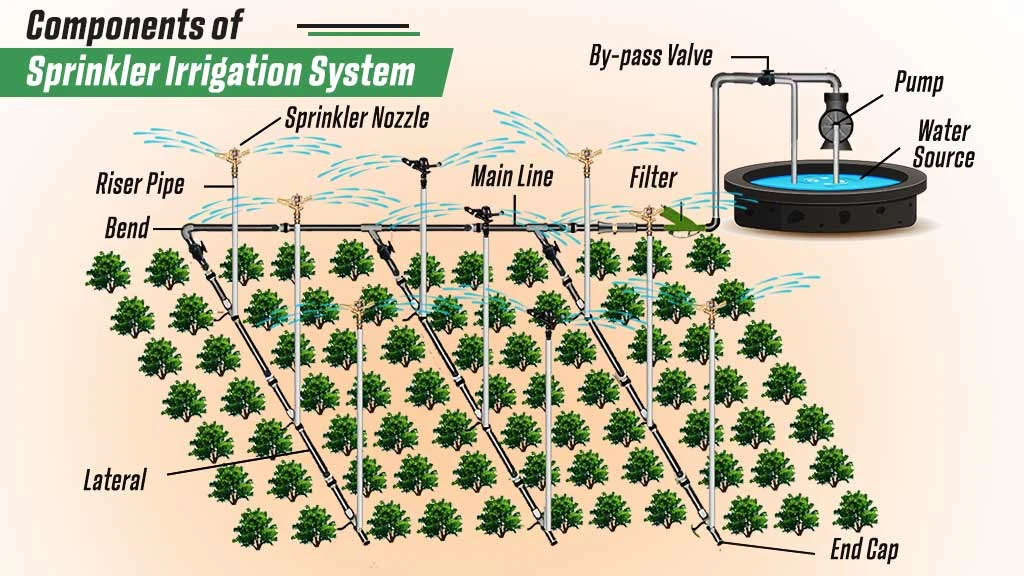
How to set up Sprinkler Irrigation System?
- Choose the right kind of sprinkler system based on your specific crop and water needs.
- Select a pump with the right flow rate, pressure head, and field coverage area.
- The spacing of your sprinkler units or pipes should be spaced as per your field crop and agro-mechanical vehicles and tools used.
- Buy a system that spreads water evenly across the entire field distance. Avoid aggressive, high-pressure water jets that can damage young crops, wash away seeds, or cause soil erosion or provoke soil crusting.
What are the Advantages of Using Sprinkler Irrigation System?
- This method helps save water up to 30% compared to traditional flood irrigation.
- It ensures uniform water distribution all over the field.
- This also helps to increase yield and is suitable for all types of soil except heavy clay soil.
- It is suitable for irrigating crops as well.
- It eliminates water conveyance channels, thereby reducing losses.
- This method can be used on uneven terrains where other irrigation methods may not be effective.
- Less problem of clogging of sprinkler nozzles due to sediment laden water.
What are some Challenges in Sprinkler Irrigation Method?
- Evaporation loss when operating under high temperatures.
- Uneven water distribution leads to difficulty in irrigation due to high winds.
- High initial cost.
- Highly impermeable soil is not suitable.
- High water pressure requirement (>2.5kg/cm2)
Is Sprinkler irrigation a cost-effective method?
Sprinkler irrigation is cost-effective because it maximizes resource efficiency and lowers long-term operational expenses. Some of its other reasons are as follows:
- The sprinkler irrigation system maximizes limited water by distributing precise amounts of water to areas where water resources are stagnant.
- It helps in labor savings as sprinkler irrigation requires minimum labor than surface irrigation.
- Since water is gently sprinkled through the field, it reduces the chances of soil erosion.
- This system can adapt to different types of crops, terrains, and soil types, which makes it a versatile and cost-effective choice.
What is the Cost of Setting up 1 Hectare Sprinkler System in India?
As per NABARD, the estimated cost for setting up 1 hectare (ha) sprinkler system is mentioned below.
|
SL No. |
Product Description |
Amount (in Rupees) |
|
1 |
Pump Set |
20,000 |
|
2 |
PVC Pipes |
56,096 |
|
3 |
Control Valve |
4,450 |
|
4 |
Sprinkler Assembly |
18,900 |
|
5 |
Screen Filter |
4,500 |
|
6 |
Fitting and Accessories |
4,197 |
|
|
Total |
1,08,000 |
Final Thoughts
Efficient water management is becoming increasingly important for Indian agriculture. Sprinkler irrigation provides farmers with a practical solution to conserve water, improve crop productivity, and reduce labour requirements.
To support the adoption of modern irrigation practices, the Government of India has introduced several initiatives, including the Pradhan Mantri Krishi Sinchayee Yojana (PMKSY). The scheme aims to expand irrigation coverage, improve water-use efficiency, and promote sustainable water conservation practices across the country.
With proper planning and implementation, sprinkler irrigation can play a significant role in making Indian agriculture more productive, sustainable, and resilient to water scarcity.
Frequently Asked Questions On Sprinkler Irrigation in India
1. What is an irrigation sprinkler?
An irrigation sprinkler is a device used to irrigate agricultural crops, lawns, landscapes, and other areas.
2. Where is sprinkler irrigation used in India?
Sprinkler irrigation is used where there is less water availability and on almost all kinds of soils except heavy clay soil.
3. Which state has highest sprinkler irrigation in India?
Rajasthan is the most irrigated state through sprinkler irrigation due to water shortage.
4. Which soil is best suited for sprinkler irrigation in India?
Light sandy soils are the best soil for sprinkler irrigation in India.
5. What are the advantages of sprinkler irrigation?
Sprinkler irrigation is suitable for almost all types of soil, helps to save water, and increases yield.






Related Blogs